Why a Gust Hauf pie tastes the way it does.
Everything on our pies is a decision. Nothing here is by accident, and nothing here is here because it's easy.
Walk into our kitchen on a Tuesday morning and the first thing you'll smell isn't pizza. It's flour and water. That's because the pie you'll eat on Friday started proofing today. Every other pizza place in the country will tell you their crust is special. Most of them are stretching the same commercial dough into a slightly different shape. Ours starts from four things: Montana spring water, high-protein bread flour, salt, and a very small amount of yeast. That's it. The rest is time.
It starts with the crust
If you've only ever had pizza from a chain, you've probably never thought about the crust much. It's the vehicle — the thing that holds the cheese and the sauce. At most places, that's true. At ours, the crust is the point. It's the thing we'd bet the restaurant on. And it's the hardest thing to get right consistently, because it's the thing we control the least once it goes into the oven.
Our dough ferments for a full 72 hours in cold storage. That long, slow cold-ferment is what develops the flavor — a slight tang, a chew, a lightness — that you can't get from a fast warm rise. It's also what makes the crust digestible in a way that mass-market dough isn't. The yeast has done its work by the time the pie hits the stone. There's nothing left to bloat you.
Hand-stretched, never rolled
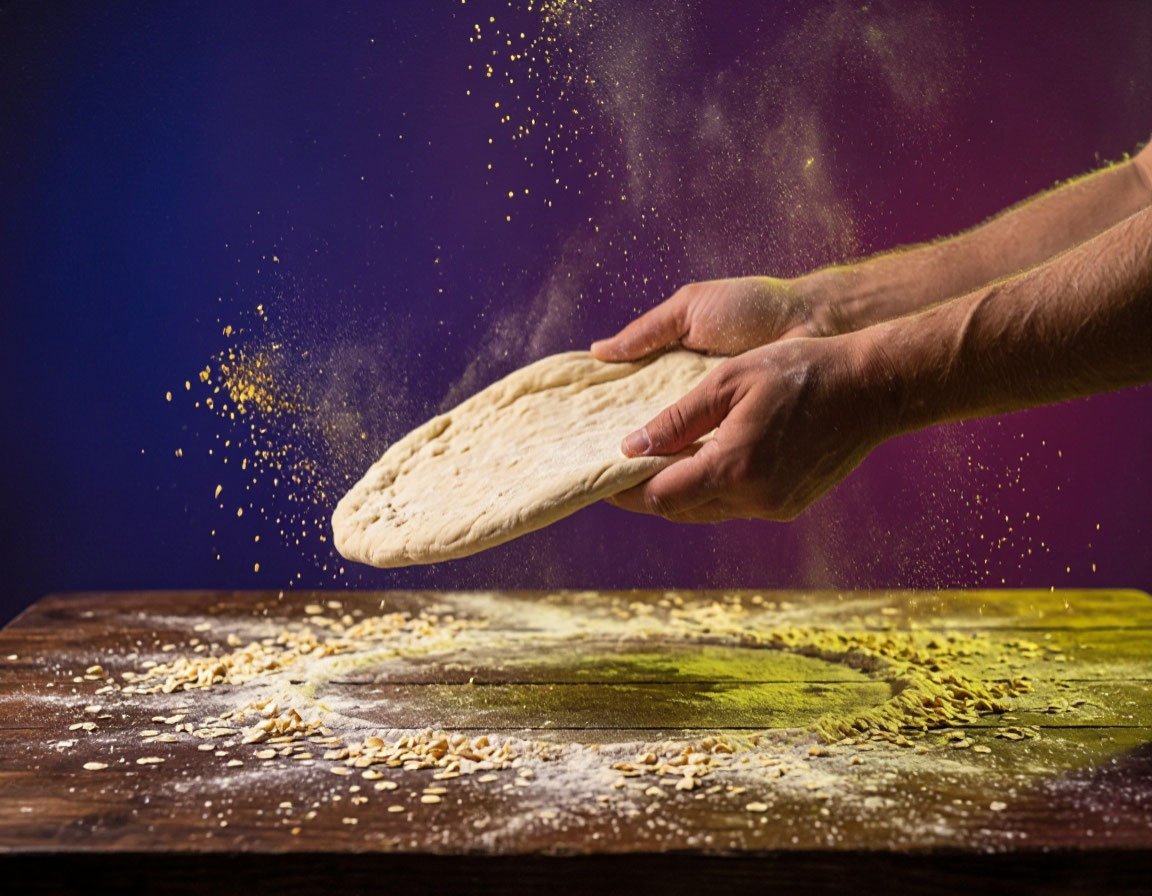
Every round is stretched by hand. We don't use a rolling pin and we don't use a press. Rolling compresses the dough and kills the gas pockets the ferment built up. Stretching keeps them alive, which is why you see a proper open crumb when you bite into our crust and a dense, cracker-like one everywhere else.
The sauce is not ketchup
Our red sauce is San Marzano tomatoes, salt, a small amount of olive oil, and nothing else. It's cooked for about twenty minutes, low and slow, and then it's done. We don't add sugar, we don't add oregano, and we don't cook it into a paste. The tomato should taste like a tomato. Anything else you add to a pizza sauce is trying to fix a tomato that didn't need to be broken in the first place.
That's also why the sauce sits on the pie in a thin layer. Too much sauce and the crust doesn't get to speak. We want a balance where you taste all three things — crust, sauce, cheese — at the same time, not one coating the others.
Cheese is not a topping
Cheese is a seasoning. That's the way to think about it. We use whole-milk, low-moisture mozzarella from a Wisconsin creamery, cut into thin slices, not shredded. Slicing instead of shredding means the cheese melts into an even sheet instead of the pools-and-gaps texture you get from pre-shredded cheese. We add fior di latte — fresh cow's-milk mozzarella — to pies where the cheese is meant to be the star, like the Margherita. And we add parmesan as a finisher on most pies, because parmesan is salt and umami and it makes everything else taste like more of itself.
We make our own toppings
House fennel sausage. House meatballs. Slow-cooked pulled chicken. Roasted peppers. Pickled jalapeños. We make everything we can in-house because we can taste the difference, and once you can taste the difference, you can't not make it. The pepperoni we buy — Cup & Char, natural casing, cup-and-char — because it's a genuinely great product that we can't improve on. Same for the prosciutto. Everything else comes out of our own kitchen.
Vegetables rotate with the season. If our neighbor has zucchini in July, we have zucchini in July. If it's a bad year for tomatoes, you'll see fewer tomato-forward pies and more pies built around something else. That's not a marketing strategy. That's just what happens when you buy locally and cook honestly.
Three sizes, one standard
We offer three sizes — 10-inch small, 14-inch medium, and 18-inch large. Every size gets the same dough, the same sauce, the same cheese. There's no scaled-down version of the recipe. The proportions change slightly to keep the crust-to-topping ratio where we want it, but there's no watering down for the smaller pies. A 10-inch Gust Hauf pizza should taste like a Gust Hauf pizza.
Vegan & gluten-free
We offer a vegan cheese — a cashew-and-coconut blend we've been working with for years — that actually melts and stretches instead of turning into a sad puddle. It's not mozzarella. It doesn't pretend to be. But it's good, and it means a vegan pizza at our place isn't an afterthought. The dough itself is naturally vegan (flour, water, salt, yeast). Just choose the vegan cheese instead of dairy mozzarella.
Our gluten-free crust is a separate dough made in a separate area of the kitchen with dedicated tools. It's a rice-flour-and-tapioca blend with a bit of psyllium husk for structure. It's not the same as our wheat crust — you're not going to mistake one for the other — but it's a good gluten-free pizza, and we take the cross-contamination risk seriously. If you have celiac disease, tell us when you order and we'll walk you through the protocol.
What comes out of the oven
A Gust Hauf pizza comes out of the oven with a blistered, leopard-spotted crust, a smell that will hit you from the door, and a bottom that holds up under the weight of everything on it. We cut it into the appropriate number of slices for the size (six for small and medium, eight for large), box it, and hand it to you. We don't put it under a heat lamp, we don't finish it in a second oven, and we don't let it sit around. From the moment it comes out to the moment it hits your car, it's about ninety seconds. That's the way it's supposed to work.
You can taste the patience. That's the whole thing.
If you want to understand what we mean, order a plain cheese pie the next time you're in Glendive. Nothing on it but crust, sauce, and cheese. That's the version of our pizza we're most proud of, because there's nowhere to hide. If it's good, it's good because the dough is good, the sauce is good, and the cheese is good. It's good because we got out of the way and let the ingredients do what they know how to do. That's the whole restaurant, on one pie.
Taste it for yourself.
The best way to understand what we do is to order it. Pickup at 300 W Bell St in Glendive.
See the Menu