How we make a Gust Hauf pie.
From the moment we mix the dough on Monday morning to the moment you pull away from the curb on Friday night, here's what's happening.
Most pizza places will tell you their pizza takes 20 minutes. They're measuring from the moment you order to the moment you take it out of the box. We're measuring something else. From the moment we mix the dough to the moment you take it out of the box is closer to seventy-two hours — because that's what a pie that actually tastes like something requires.
Here's what happens in that seventy-two hours, in order.
1. Mixing · Monday, 8 AM
We start with four ingredients: high-protein bread flour, Montana spring water, sea salt, and a small amount of commercial yeast. The flour-to-water ratio is precise — around 62% hydration — because that ratio determines how the dough will behave two days from now, not how it behaves today. We mix it in a spiral mixer for about ten minutes, until the gluten fully develops. You can see it happen if you watch: the dough goes from a shaggy mess to a smooth, elastic ball. When it's ready, we portion it immediately into balls of the right weight for each size, because cold dough is hard to portion evenly and warm dough is impossible to shape cleanly. Then it goes straight into the walk-in.
2. Cold ferment · 72 hours
This is the part that can't be rushed, and it's the part most pizza places skip. Our dough balls sit in a 38°F walk-in cooler for three full days. During that time, the yeast is eating sugar and producing carbon dioxide — but very, very slowly, because of the cold. Slow fermentation is what develops flavor. The fast-warm-rise dough you find at most places is pale and flat-tasting because it hasn't had time to build any complexity. Ours has had three days.
The ferment also changes the texture. Cold-fermented dough is easier to stretch, more forgiving, and holds gas better in the oven. It's a completely different product than what you'd get from the same flour on a two-hour rise. And crucially: it's more digestible. The yeast has done its work by the time the pie goes in the oven, which means less bloat and more flavor.
Three days of doing nothing is what makes a Gust Hauf pie taste the way it does. That's a hard thing to sell. It's a harder thing to shortcut.
3. Hand-stretch · 20 seconds per pie
When an order comes in, the dough ball leaves the cooler, gets a light dusting of flour, and gets stretched by hand. We don't use a rolling pin (kills the gas), a press (kills the gas), or a dough docker (kills the gas). We use our fingers, starting from the middle and working outward, letting the dough's own elasticity do most of the work. The whole process takes about twenty seconds. The result is a round that's slightly irregular at the edge — that's a feature, not a bug — with a perimeter that's thicker than the middle. That thicker edge is the crust you see puffed up and blistered when the pie comes out. It's what makes the pie taste like a pie and not a cracker.
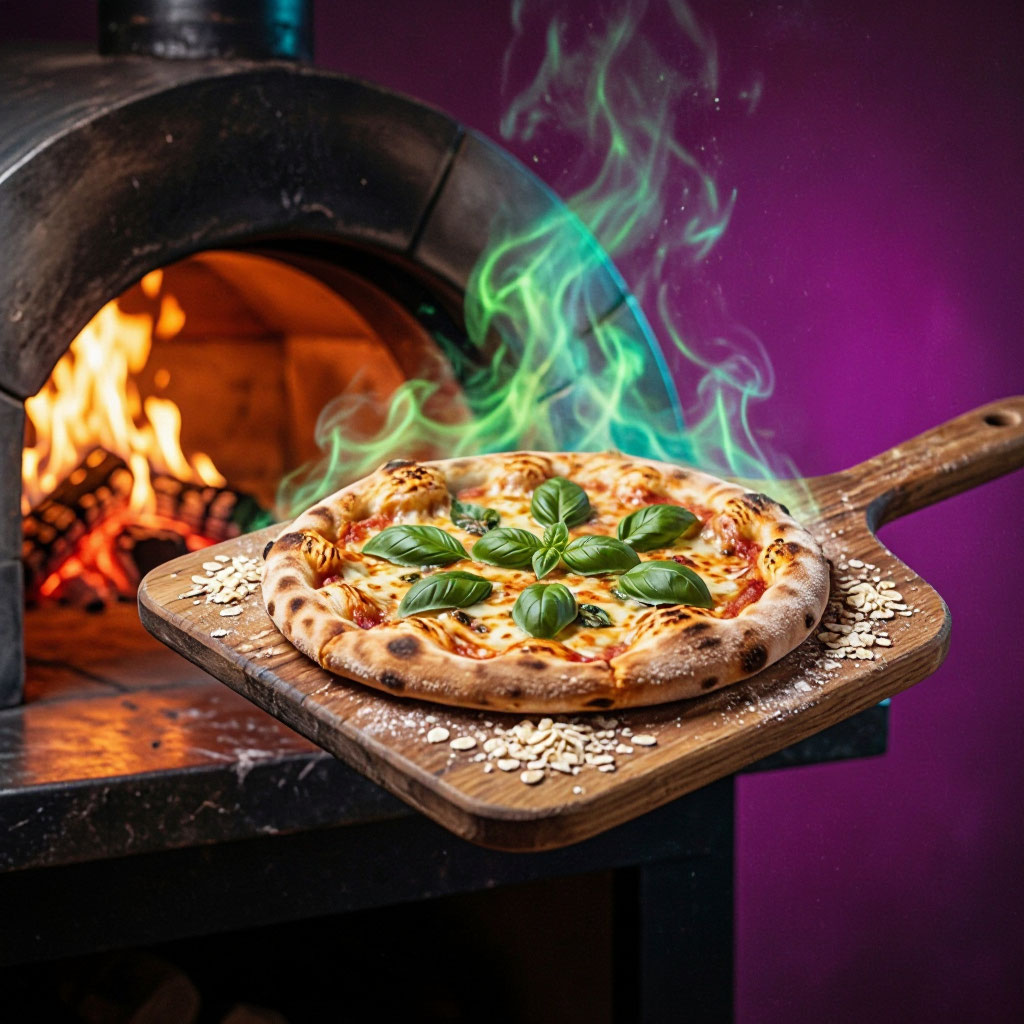
Hand-stretched, then dressed
Once stretched, the pie goes onto a wooden peel, gets a thin layer of sauce (spread in a spiral from the center, leaving a one-inch border), a layer of cheese, and whatever toppings the pie calls for. Then a quick dusting of semolina on the peel and it's ready for the oven. The whole dressing process takes about thirty seconds.
4. The oven · 550°F stone deck
Our deck oven is a stone-lined box that holds a constant 550°F. It's not a wood-fired dome (though we love those), it's not a conveyor belt (which can't produce proper char), and it's not a convection oven (which dries out the crust before it can blister). It's a stone deck — the pie sits directly on the heated stone, gets conduction heat from below and radiant heat from above. The stone is what gives the bottom of the crust its characteristic crisp-and-char. No stone, no pizza. That's just the physics.
We rotate the pie ninety degrees about two-thirds of the way through the bake to even out the oven's hot spots. Every deck oven has them. Rotating is what separates a pie that's evenly blistered from one that's burnt on one side and pale on the other.
5. Six minutes · the bake
Total bake time: about six minutes. In that time, the dough puffs up, the cheese melts into a proper sheet, the sauce bubbles at the edges, and the crust develops those dark leopard spots we're looking for. Under four minutes and the inside of the dough hasn't set properly. Over eight and the crust is dry before the toppings have finished cooking. Six is the number that gets you both — a fully cooked center and toppings that still taste like themselves.
The blisters on the crust — those dark brown or nearly black spots — aren't burnt. They're what happens when the dough has enough sugar content from the ferment and the oven is hot enough. Blisters mean the pie was made with real fermented dough, baked in a real stone deck, at real temperature. No blister, no proof. If you see a pie with zero blistering, someone was scared of the oven.
6. Rest, cut, box · 90 seconds
When the pie comes out, it rests for about thirty seconds. This does two things: it lets the cheese set slightly (so it doesn't slide off when you cut), and it lets the crust finish steaming internally so the crumb isn't soggy. Then it gets cut — six slices for small and medium, eight for large — with a wheel cutter, not a knife. A knife pushes the toppings around and tears the crust. A wheel cutter is a single smooth motion.
Then it goes into a cardboard box with proper ventilation holes. We don't use fancy boxes. We use boxes that let steam escape, which is the single most important thing a pizza box needs to do. A pie that comes out of the oven perfectly will be soggy in eight minutes if it's boxed in something airtight. Our boxes are the cheapest thing in our kitchen and the most important after the oven.
Why we won't rush it
Every shortcut we could take here would save us time and cost us taste. We could buy pre-made dough from a big distributor. We could use a conveyor oven. We could stretch with a press. We could skip the cold-ferment and do a two-hour room-temperature rise. We could par-bake our crusts in the morning and finish them at night. Every single one of those shortcuts is standard practice in the pizza industry. Every single one of them produces a pizza that's inferior to what we make.
We're not trying to be precious about this. We're not trying to impress anybody with how hard we work. We're trying to make the best pizza we know how to make, and this is how you do that. The fact that it takes three days is not a marketing gimmick. It's just the truth about how long it takes for dough to taste like something.
Come try it. Order a plain cheese pie. Then tell us it was worth the wait.
Come taste the process.
Order online for pickup at 300 W Bell St in Glendive, or just walk in and we'll get you started.
See the Menu